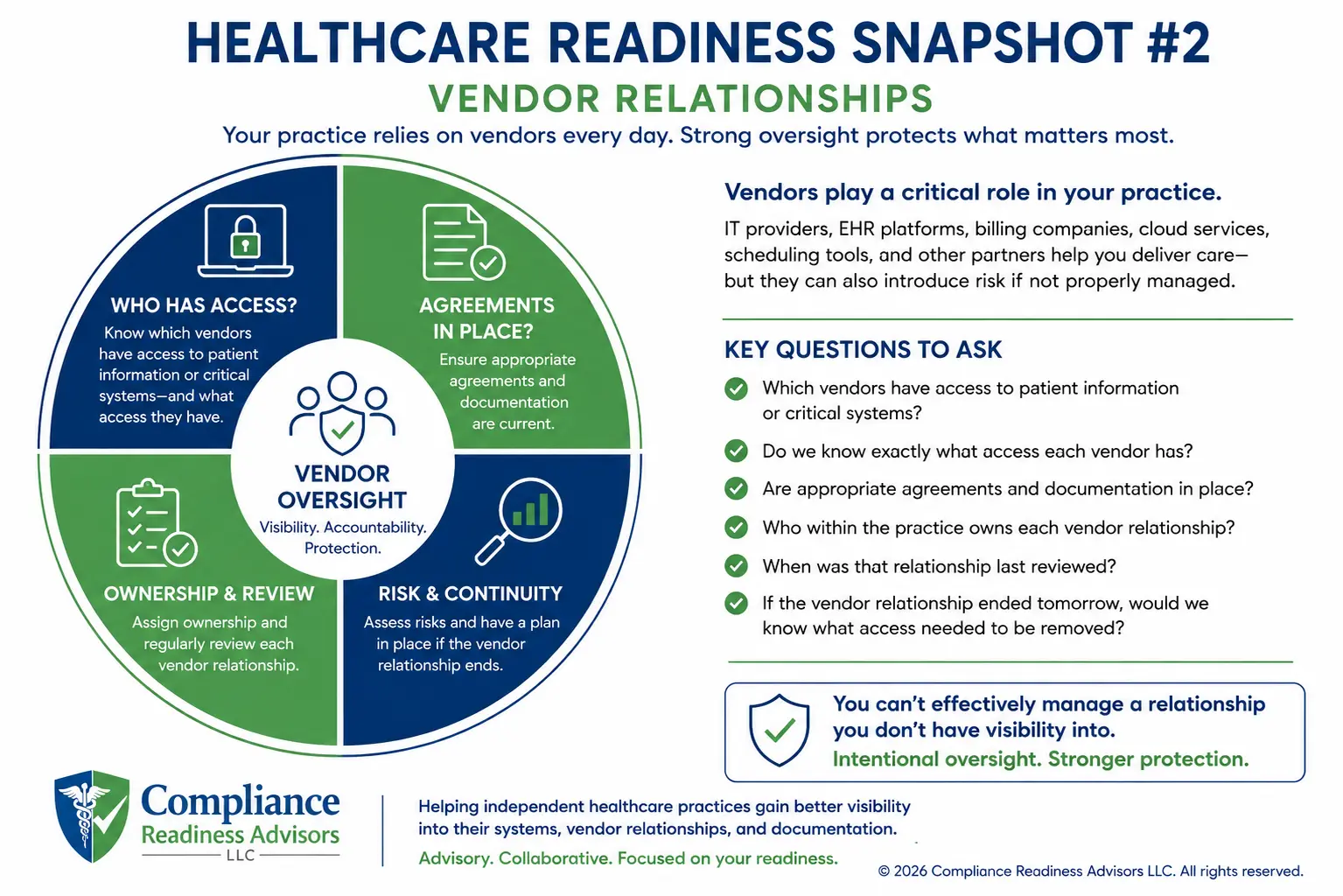
Your practice relies on vendors every day. Strong oversight begins with knowing who has access, who owns the relationship, and what happens when that relationship changes.
2SNAPSHOT
Healthcare Readiness Snapshot #2 from Compliance Readiness Advisors
The broader picture
Vendor oversight is about more than knowing who your vendors are.
IT providers, EHR platforms, billing companies, cloud services, scheduling tools, and other partners help healthcare practices deliver care. Some of those relationships also involve patient information, privileged access, or systems that are essential to daily operations.
A vendor can be doing exactly what the practice hired it to do and still introduce risk that deserves attention. The goal is not to distrust vendors. It is to understand the relationship well enough to manage it intentionally.
What to look across
Four parts of intentional vendor oversight.
01
Access
Know which vendors can reach patient information or critical systems and understand exactly what level of access each one has.
02
Agreements
Confirm that appropriate agreements and supporting documentation are present, current, and connected to the actual service being provided.
03
Ownership and review
Assign an internal owner and establish a practical way to revisit access, performance, responsibilities, and changes over time.
04
Risk and continuity
Consider how the practice would remove access, recover information, and maintain operations if the relationship ended or the vendor became unavailable.
You cannot effectively manage a relationship you do not have visibility into.